
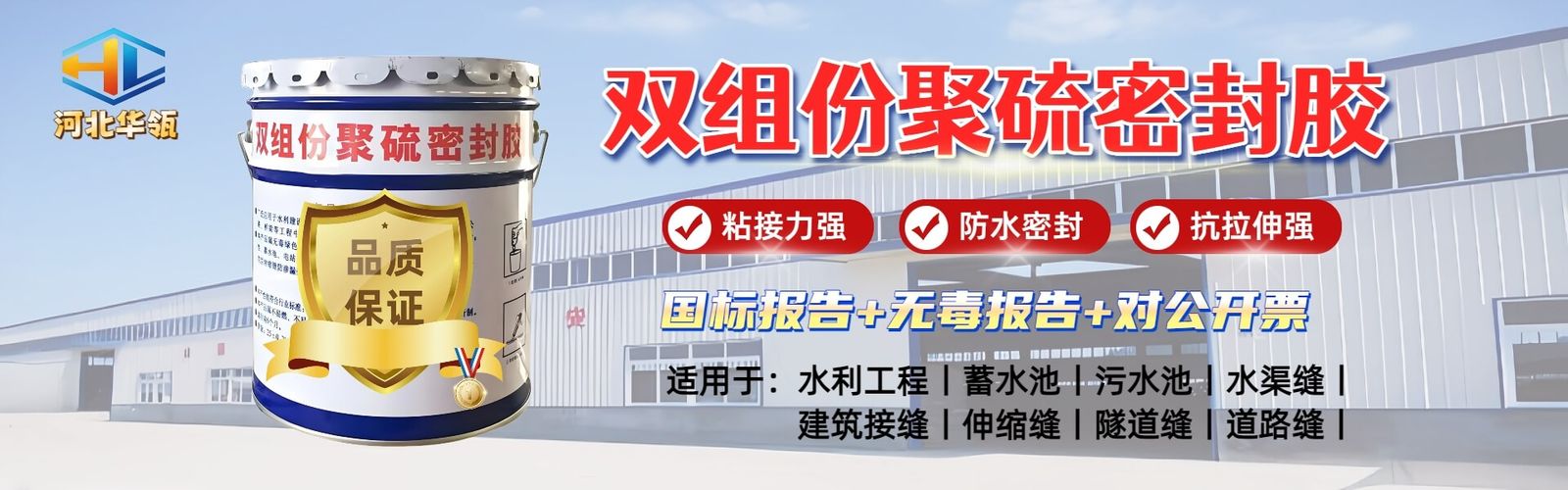
Key points
- Standard: JC/T 483-2022; graded and tested by an accredited third-party laboratory.
- Grades: N20LM and N25LM (low modulus); N20HM and N25HM (high modulus).
- Price: RMB 4–10 per kg, depending on modulus, movement capability and tensile performance. MOQ: 1 drum minimum; orders up to 10 t ship in 1 day.
- Inspection commitment: pre-purchase sampling, third-party re-testing, full refund if a test fails.
Overview
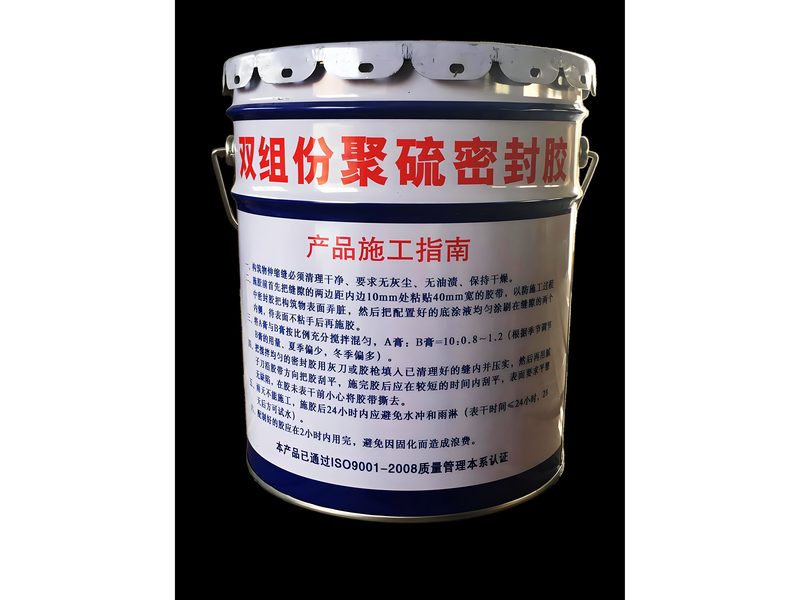
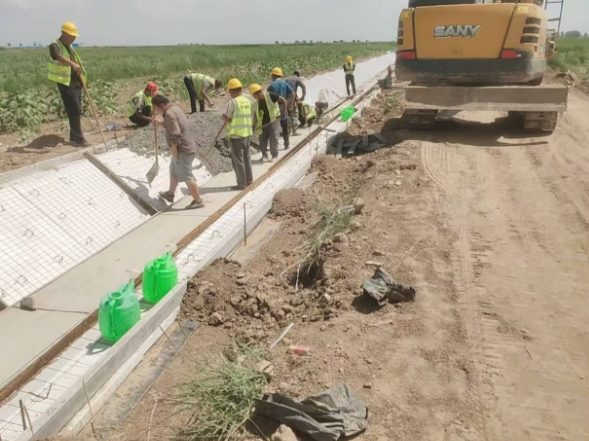
Two-component polysulfide sealant is based on liquid polysulfide rubber, cured at room temperature after mixing parts A and B into an elastic sealing body. It is used for expansion, movement and settlement joints in water conservancy tanks, sewage treatment basins, tunnels, culverts, bridges and underground works, and is particularly suited to permanent immersion conditions.
Technical data
| Property | Measured | Requirement |
|---|---|---|
| Density | 1.6 g/cm³ | Nominal ±0.1 g/cm³ |
| Flow / sag, type N | 1 mm | ≤3 mm |
| Skin formation time | 10 h | ≤24 h |
| Tooling life | 8.5 h | ≥2 h |
| Tensile modulus at 23 °C | 0.2 MPa | ≤0.4 MPa |
| Tensile modulus at -20 °C | 0.2 MPa | ≤0.6 MPa |
| Elastic recovery | 81 % | ≥80 % |
| Adhesion at constant extension | No failure | No failure |
| Adhesion at constant extension after immersion | No failure | No failure |
| Adhesion after cold draw / hot press | No failure | No failure |
| Mass loss | 3 % | ≤5 % |
| Low-temperature flexibility, -40 °C | No cracking | No cracking |
| Adhesion at constant extension after 28 d immersion | No failure | No failure |
Advantages
- Low-modulus grades reach ≥400% elongation and follow joints with large movement — suited to engineering joints with significant displacement.
- Water-, oil- and ageing-resistant. After cure it tolerates permanent immersion without debonding or cracking.
- Passed GB/T 17219 hygiene assessment for drinking-water contact materials, so it can be used in clear-water basins and potable water structures.
- No cracking at -40 °C; no flow at 120 °C.
- Pre-purchase sampling, third-party re-testing, full refund if a test fails.
Applications
- Hydraulic gate seals, box culverts and reservoirs
- Sewage treatment basins and water plant filter tanks
- Settlement joints in utility tunnels
- Basement slab and retaining wall joints
- Tunnel lining joints (sheltered from sunlight)
Installation
- Prepare the substrate: remove laitance, oil and standing water. Do not apply over standing water.
- Place closed-cell PE foam board as a backer so the bead depth is 1/2–2/3 of the joint width; mask the joint faces with tape.
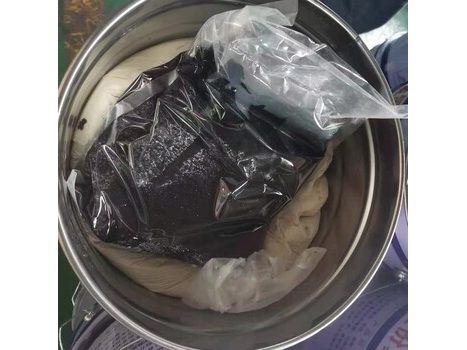
- Weigh components A and B on a scale at the specified ratio (normally 10:1 by weight — follow the datasheet) and mix with a power stirrer for 3–5 minutes until the colour is uniform.
- Inject with a caulking gun, then tool and press with a spatula so the sealant bonds tightly to both concrete faces and no triangular voids remain.
- No water, load or rain before cure. Basins and canals must be fully cured before filling.
FAQ
Normally A:B = 10:1 by weight; some batches range from 100:8 to 100:12, so follow the datasheet. Weigh on a scale and mix with a power stirrer for 3–5 minutes until the colour is uniform. An inaccurate ratio or poor mixing can leave the sealant permanently soft, or cure it brittle and inelastic; excess B causes reverse vulcanisation and the batch is scrap.
At 25 °C skin formation takes about 2–8 hours (10 hours measured on the batch we tested) and full cure takes 3–7 days. Lower temperature and higher humidity both slow it down. No water, load or rain before cure. Basins and canals must be fully cured before filling, and winter work needs a longer curing period.
Work out the volume from width × depth: kg per metre ≈ width (mm) × depth (mm) × density (about 1.5–1.6 g/cm³) ÷ 1000. A 20 mm × 20 mm joint needs roughly 0.6 kg/m, plus 5–10% for loss. Place closed-cell foam board at the bottom of the joint to control depth.
Polysulfide for permanent immersion and contact with oils; polyurethane where high strength and fast cure matter. Polysulfide is stronger on water, oil and ageing resistance, tolerates permanent immersion and suits hydraulic, tunnel and bridge expansion joints. Polyurethane has higher mechanical properties but is weaker under permanent immersion.
Yes. It has passed GB/T 17219 hygiene assessment for drinking-water contact materials, with colour, turbidity, heavy metals and volatile phenols all within limits, so it is suitable for clear-water basins and potable water works.
Price and delivery
| Reference price | RMB 4–10 per kg, depending on modulus, movement capability and tensile performance |
|---|---|
| MOQ and lead time | 1 drum minimum; orders up to 10 t ship in 1 day |
| Packaging | Palletised drums, woven bags or cartons; LCL and FCL shipping available. |
Related products
Contact
- Company
- Hebei Hualing Rubber Co., Ltd.
- Address
- No.97, Xifantun Village, Wuqiang Town, Wuqiang County, Hengshui City, Hebei Province, China
- Contact
- Mr. Hou (Sales Manager)
- Tel
- +86 13081809758
- mifengjiaochang@163.com